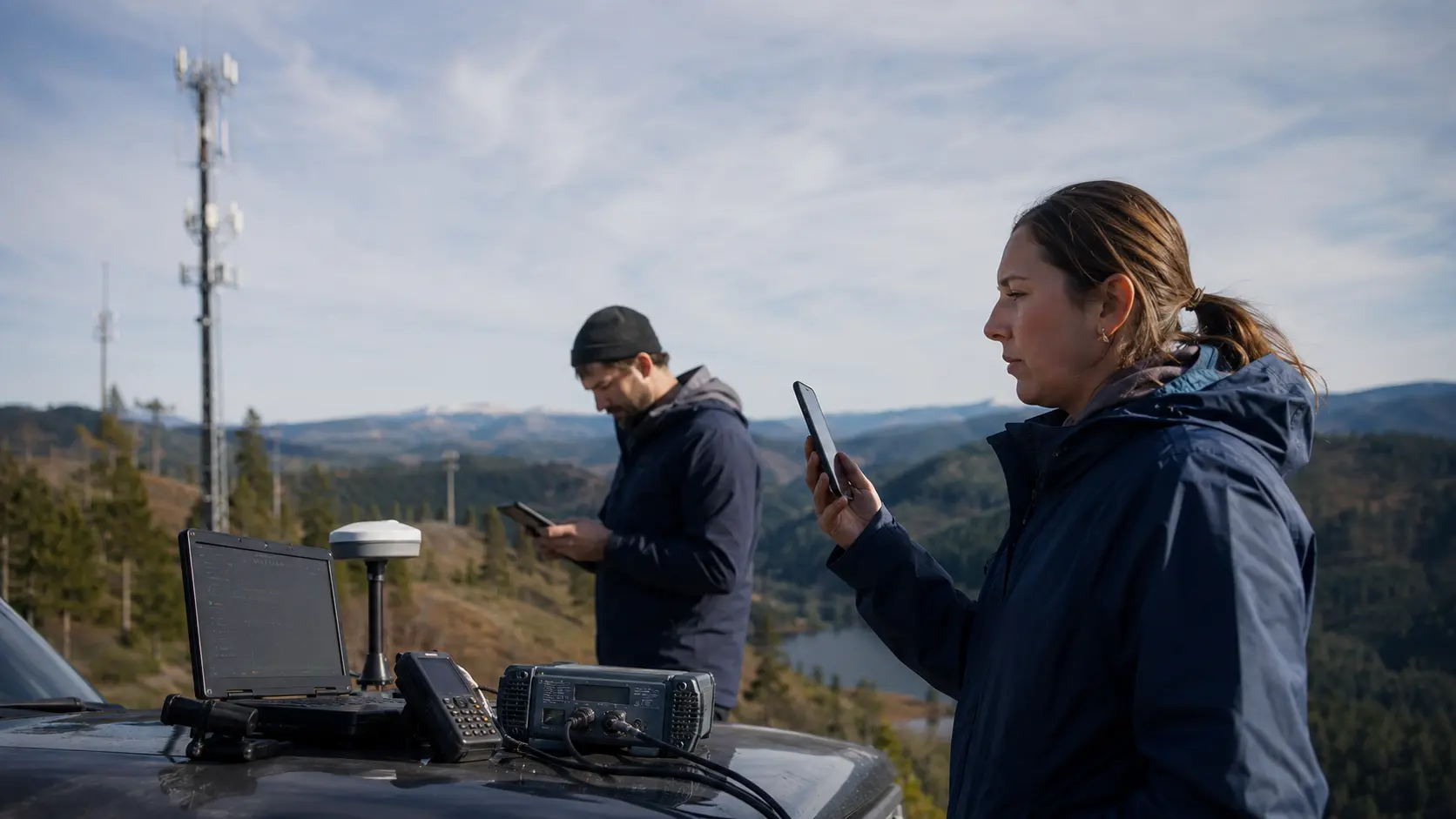
Satellite-to-device service begins with a compelling promise: connectivity where terrestrial coverage ends. Engineering begins by converting that promise into observable events and repeatable conditions.
Start with the service that exists
Current offerings vary by operator, device, geography and maturity. Depending on the ecosystem, the available experience may include emergency or two-way messaging and selected satellite-ready data applications. The test plan must identify the exact commercial feature, device and plan being evaluated—not the roadmap.
Measure the complete transaction
Record service discovery, satellite acquisition, message submission, network acknowledgement and end-to-end delivery. Preserve timestamps, GNSS position, device state, orientation, sky visibility and terrestrial registration so success and failure have context.
Geometry changes the experiment
Terrain, buildings, foliage, vehicle body, user orientation and moving orbital geometry affect opportunity. A single successful message proves possibility; it does not establish availability. Repeat across locations, time windows and controlled obstructions.
Test the boundary between networks
The interesting behavior occurs when terrestrial service degrades, disappears or returns. Observe selection logic, acquisition delay, user prompts, battery impact, queued-message behavior and recovery. Hybrid continuity is a workflow, not merely two coverage layers.
Build a framework that can mature
Messaging metrics create the first baseline. As NTN evolves, the same evidence model can add voice setup, data throughput, latency, mobility, application QoE and comparative device performance without rewriting the engineering question.