DIGITAL TWIN ENGINEERING

Engineer the living system behind the visualization.

We connect MBSE, semantic models, telemetry, physics, geospatial context and lifecycle configuration to create federated Digital Twins that remain traceable from requirement to operational decision.

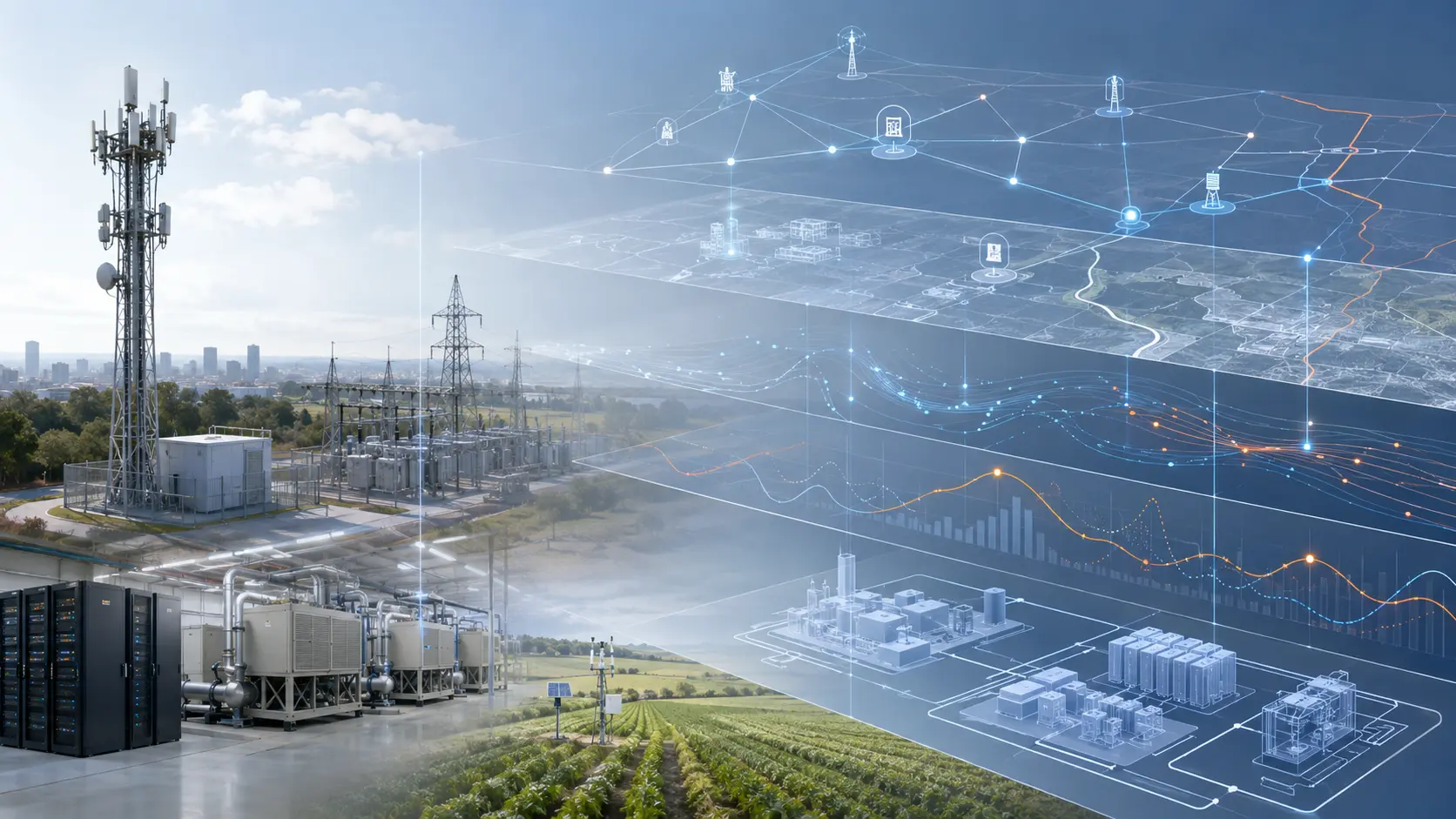
Cross-domain infrastructure represented as operational Digital Twin systems

FEDERATED SYSTEM-OF-SYSTEMS VIEW

See the architecture behind the twin.

Expand the visual to inspect physical domains, synchronized models, semantic relationships and lifecycle context.

THREE ENGAGEMENT PATHS

Build it. Architect it. Master it.

Start with a business question, a system boundary and evidence. Then select the models, fidelity and synchronization required—without buying complexity that the use case cannot justify.

01 · BUILD

Digital Twin Engineering

Reference architecture, semantic layer, state estimation, event ingestion, visualization, simulation and decision workflows.

  • System-of-interest definition
  • Model/data integration
  • Prototype through operational MVP
  • Verification and validation
02 · ADVISE

Architecture & Readiness

Vendor-neutral discovery connecting business outcomes to model fidelity, data availability, interoperability and operating governance.

  • Use-case and maturity assessment
  • MBSE-informed architecture
  • Federation and integration roadmap
  • Lifecycle and governance model
03 · ENABLE

Digital Twin Academy

Role-based programs that move teams from vocabulary to architecture, model orchestration and a defensible domain prototype.

  • Executive and product tracks
  • Architect/engineer bootcamps
  • Domain labs and capstones
  • Build-with-your-data workshops

REFERENCE ARCHITECTURE

A twin is a governed system of models.

Its value comes from disciplined relationships among models, data, configuration and decisions—not from one monolithic platform.

MBSE & System Architecture

Mission, requirements, functions, interfaces, behaviors and verification remain connected to the operational twin.

Semantic Layer

Ontologies and knowledge graphs establish machine-readable meaning across assets, events, capabilities, policies and locations.

Federated Twins

Domain twins preserve ownership and fidelity while participating in a governed system-of-systems composition.

Digital Thread

Traceability across requirements, design, configuration, deployment, operation, maintenance and retirement.

Synchronization

Telemetry, events, state estimation and temporal alignment keep the virtual representation consistent with observed reality.

Simulation & Co-simulation

Physics, discrete-event, agent-based and data-driven models orchestrated for scenario and impact analysis.

V&V and Uncertainty

Model validity, calibration, confidence bounds, provenance and fitness-for-purpose are explicit and reviewable.

Interoperability & Governance

APIs, schemas, identity, access, model ownership, configuration control and lifecycle policies support responsible scale.
TWIN MATURITY

Progress from visibility to decision advantage.

01 · DESCRIPTIVEWhat exists and what is happening?
02 · DIAGNOSTICWhy is the system behaving this way?
03 · PREDICTIVEWhat is likely to happen next?
04 · PRESCRIPTIVEWhich intervention best satisfies the constraints?
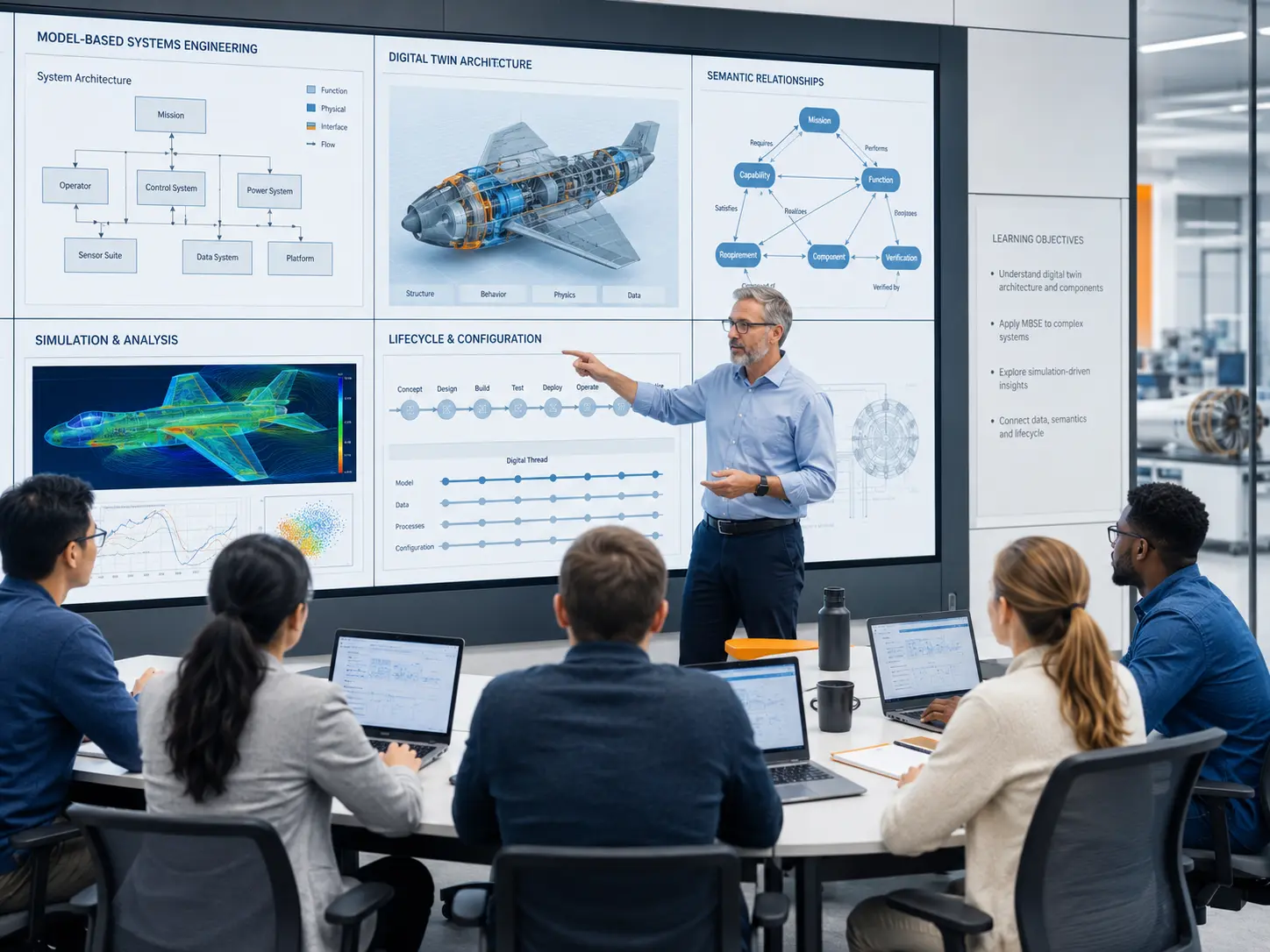
Digital Twin Academy workshop covering MBSE, semantic relationships, simulation, digital thread and lifecycle configuration

DIGITAL TWIN ACADEMY

Learn to think in systems, models and evidence.

The Academy develops architectural judgment—not platform-specific button knowledge. Teams learn to define the system of interest, establish semantic contracts, select model fidelity, design federation boundaries, orchestrate simulations and validate whether a twin is trustworthy enough for its intended decision.

Programs can be executive, technical or domain-specific, culminating in a reference architecture or working prototype built around your own use case.

DOMAIN APPLICATIONS

Deep models for real operating environments.

Telecom & Private Networks

Topology, propagation, capacity, mobility, service experience and change scenarios.

Utilities & Critical Infrastructure

Network state, field assets, dependency propagation, resilience and restoration.

Data Centers & Cooling

Power/thermal behavior, liquid-cooling loops, capacity and maintenance scenarios.

GIS & Built Environment

Terrain, parcels, facilities, subsurface systems, GeoBIM and mobile operations.

Smart Agriculture

Fields, connectivity, sensors, irrigation, equipment and autonomous workflows.

Enterprise Operations

Resources, processes, constraints, policies and outcome simulation.